
Colombian trapiche emeralds
The six-spoke wheel pattern, formed naturally in the black shales of Boyacá. Stones bought at source, certified by an independent laboratory.
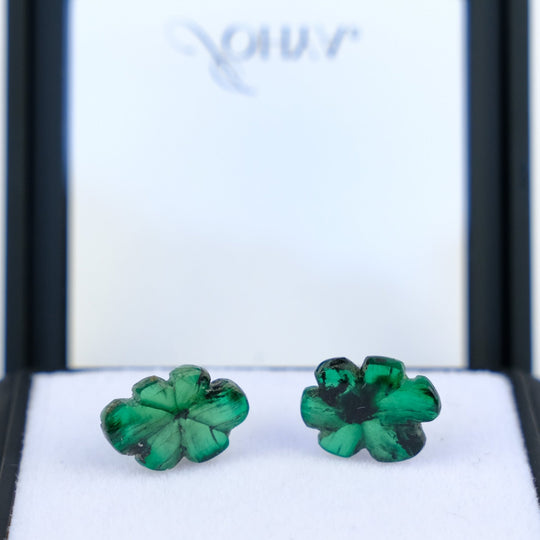
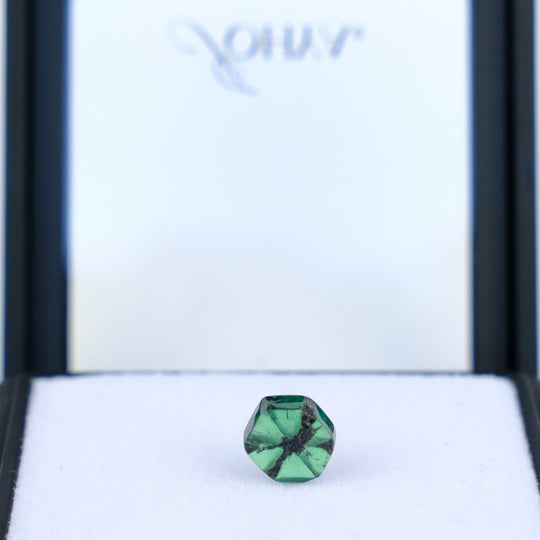
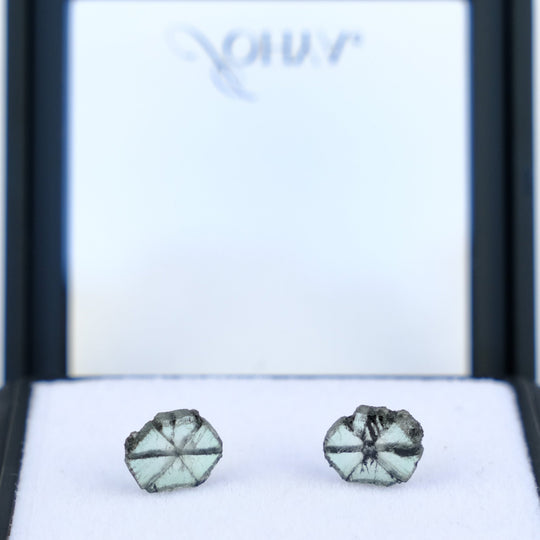
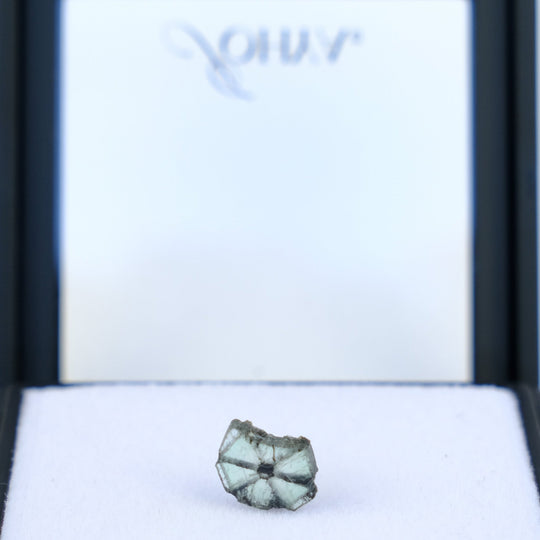
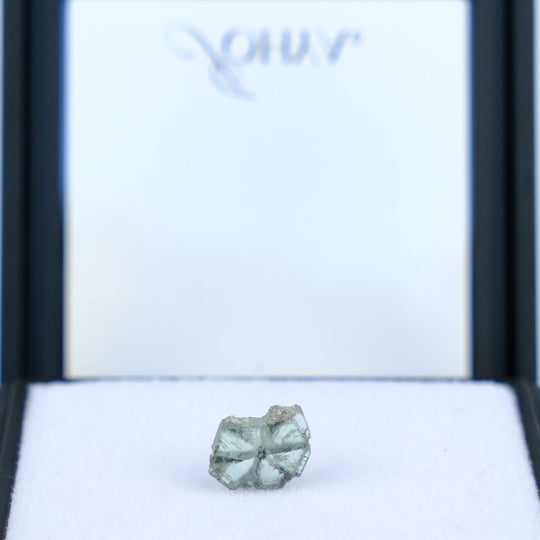

Colombian trapiche emeralds, bought at the source and certified. The six-spoke pattern forms while the crystal grows, it is not cut into the stone. Every stone on this page carries its weight, its dimensions and the degree of treatment recorded by the laboratory. Single stones or pairs for earrings, cut as slices or cabochons, with the price per carat including tax on every card.
What a trapiche emerald is
The trapiche is an emerald whose crystal shows six green sectors radiating around a core, separated by dark arms of carbonaceous inclusions trapped during growth. The word comes from Spanish, the wheel of the sugar-cane mill, whose spokes the stone reproduces. It is not a twin, the six sectors share the same crystal orientation, as our article on emerald twinning explains. The pattern requires black shales saturated with carbonaceous matter, the geology of Colombia's two belts, Muzo, Peñas Blancas and Coscuez in the west, Chivor in the east (see the Colombian emerald mines), which explains why it remains almost impossible to find in France.
How to judge a trapiche, and what it costs
A trapiche is not judged like a faceted stone. Color counts, but the pattern counts more. Thin, continuous, well drawn arms are worth far more than a diffuse pattern. An even wheel with the core at the center is rare. The green of the sectors has to stand out against the dark of the arms, and supply becomes very thin above 3 carats. At equal weight, a trapiche is worth less than a faceted emerald of fine color, because it is less transparent. A trapiche with a very crisp pattern is paid for on its drawing, not on its weight. The treatment of each trapiche on this page is taken from the laboratory report, its nature as well as its degree. Our trapiches range from €580 to €6,700 including tax, roughly €300 to €1,265 per carat.
Buying a trapiche emerald from Johya
Every trapiche on this page was bought in hand during our trips to Colombia, then certified by an independent laboratory. Our product pages state Colombian origin, the only mention a certificate can attest. The stones are cut as slices or cabochons to show the whole wheel, and are set flat, in rings or pendants. Prices shown including tax, insured FedEx shipping, hand delivery possible anywhere in the world. To compare with our faceted stones, see all our Colombian emeralds, and for a specific search, the custom order.
Frequently asked questions about trapiche emeralds
Do all trapiche emeralds come from Colombia?
Almost all. The pattern requires carbon-rich black shales, the geology specific to Colombian deposits. Our product pages state the origin attested by the laboratory.
Is a trapiche more expensive than a classic emerald?
Its price works differently. At equal carat weight it is worth less than a faceted stone of fine color, but a sharp, symmetrical, contrasted pattern is rare and commands a price.
Is the trapiche a twin?
No. In a twin, several crystals of different orientations are joined. In a trapiche, the six sectors share the same orientation.
Can a trapiche be set in jewelry?
Yes, that is the most common use. Cut as a slice or cabochon, it is set flat to show the whole wheel.
